

Last week I tried a new hiking trail in the McDowell Sonoran Preserve in Scottsdale. The trail is called Lost Dog Wash Trail, and it was a good hike – not too strenuous but a good workout. Along the way I was able to stop and take a few pictures of some of the cacti along the trail. Since we just had Groundhog Day, and I don’t know of a ‘groundhog cactus’, I thought this week’s Cactus Corner will be about the hedgehog cactus. The genus is Echinocereus, and there are several species in this group. The hedgehog cactus located in the Phoenix/Scottsdale area is the Englemann hedgehog, Echinocereus engelmannii, named after 19th century botanist George Englemann. There are several varieties, including one in my area (var. acicularis). I believe that the picture below is the regular Englemann because it has white spines, whereas var. acicularis has yellow to brownish red spines. These were plentiful along the hike and were close enough to the path that I was able to get good pictures.


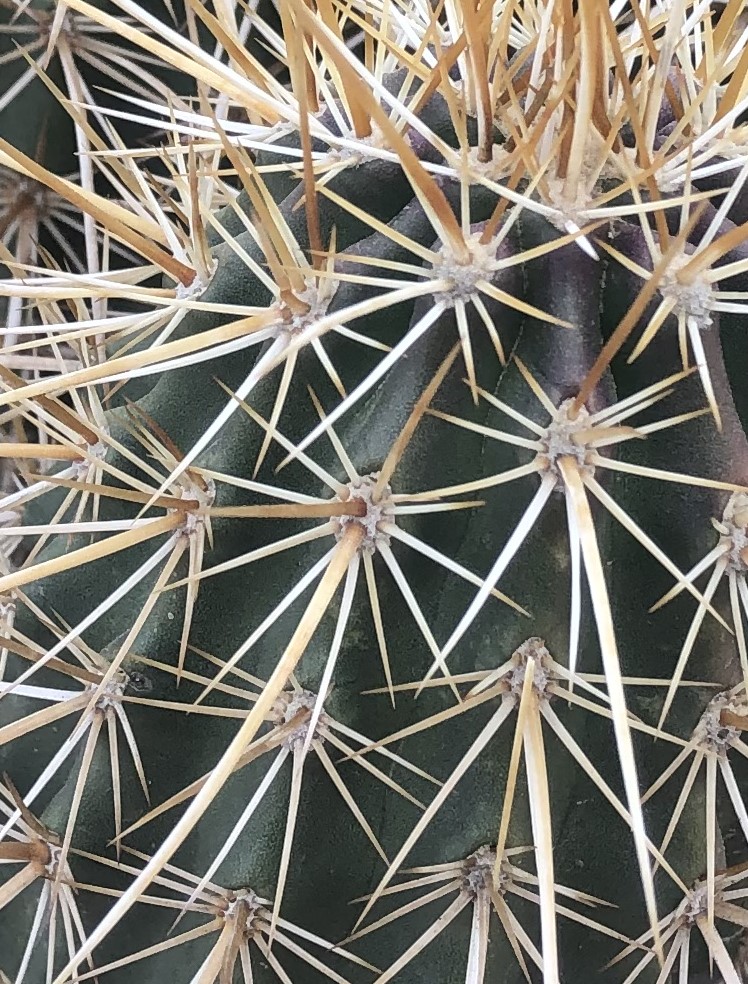
These cacti grow in clumps, with each columnar stem branching from the base of the plant. Each clump can grow as high as 2 feet tall and 3 feet in diameter, but most of the ones I encounter are not that large. The spines can be a variety of colors, ranging from white or gray to darker colors, yellow to brown, and even purple. The tips may appear darker than the base of the spine. The central spines can be up to 3 inches long, with the radial spines being variable in length, as you can see from the close-up photograph above.
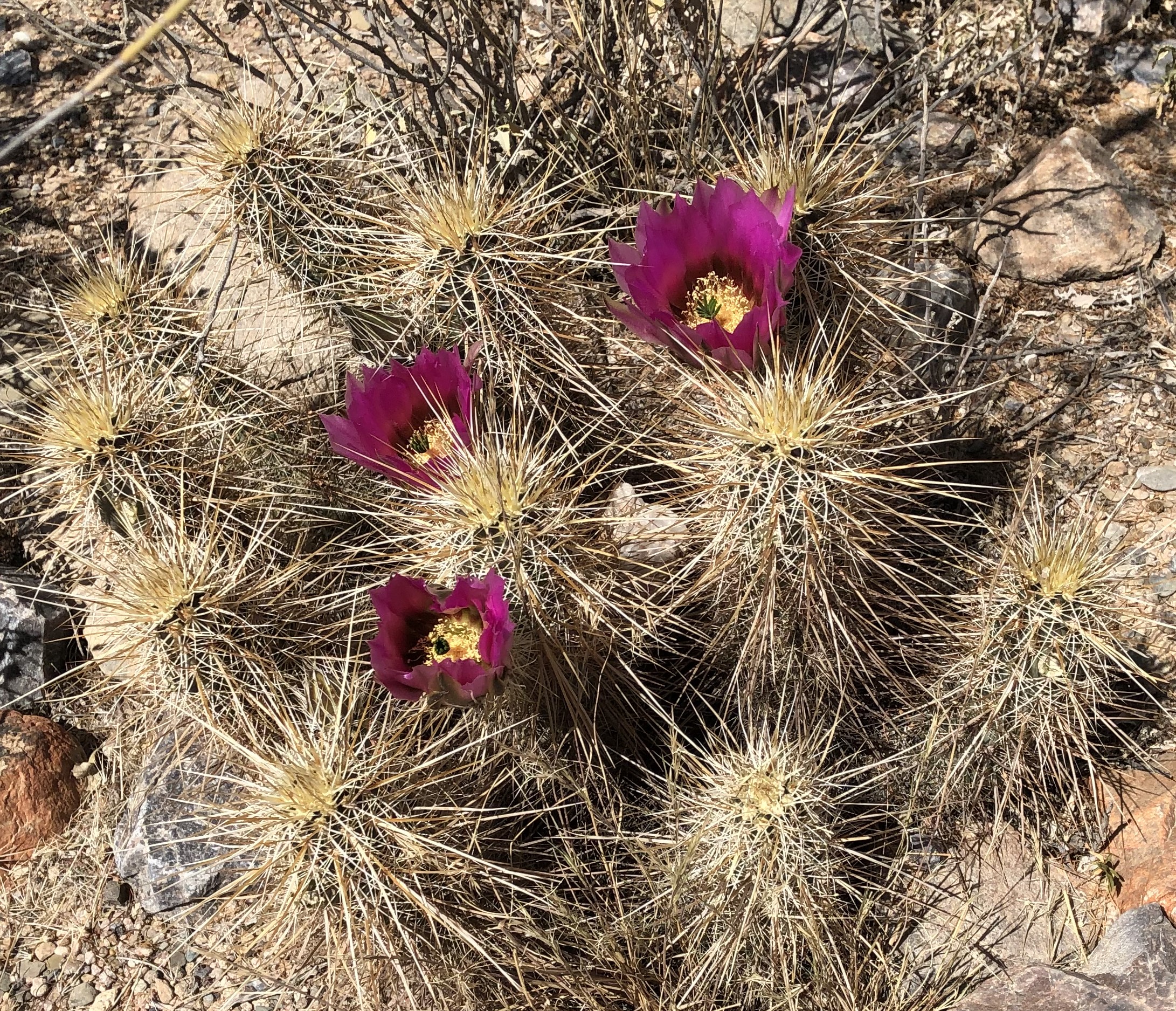
Back in the spring I photographed a hedgehog cactus in bloom. I was at the Tonto National Monument. Based on the location, I believe that this one is could be Echinocereus bonkerae, named after 20th century botanist Francis Bonker and also called the Bonker hedgehog. It is hard to tell the difference between the Bonker and the Engelmann because the Bonker hedgehog has long- and a short-spined varieties – the long-spined Bonker and regular Englemann look a lot alike to me. As an amateur, the flowers are often helpful to me for identification. These magenta flowers are dramatic and could help distinguish from other species and variants that have different colored flowers, particularly when it is hard to count the ribs on the stem when they are obscured by spines. However, both the Englemann and Bonker hedgehogs have magenta flowers. So the mystery remains for now.
In the picture below, which was taken in Saguaro National Park near Tucson, without flowers it is difficult to tell what species this might be. There are a few Echinocereus species that grow in the Tucson area, and they all look very similar to me without flowers. I also did not have time to get down and count the central and radial spines, which probably would have helped (I was not alone on that trip and no one has patience for me to stare at cacti for too long!). I am not even sure these two are the same species (or two variants of the same species) because the lengths of the radial spines are so different. I still have a lot to learn about the hedgehog cactus and its relatives, and I am happy to take you along on the learning journey. For now, I am happy to be able to identify the hedgehog cactus on my hikes and know it is Echinocereus.


 Michelle Rambles