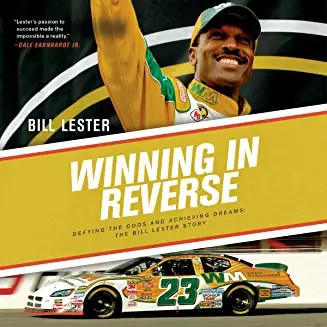
The week is the Daytona 500, so I have added two books to list of books I am currently reading. I recently found these while browsing at the library, and both had been on my to-be-read (TBR) list for awhile. The first is Racing to the Finish: My Story by Dale Earnhardt, Jr with Ryan McGee, and the second is Winning in Reverse by Bill Lester.

Racing to the Finish is actually the second Dale Jr book – the first is Driver #8: Dale Earnhardt, Jr, by Jade Gurss, which is also on my TBR list. However, I think it is fine for me to read them backwards because I am actually more familiar with the end of Dale Jr’s career than the beginning. For some background, I grew up listening to Nascar races on the radio and watching them on television. I became an even more avid fan in the early 90s when Jeff Gordon was moving through the ranks toward stardom – we were the same age, and I was in college while he was out there living the dream, so I was a fan. Eventually, in the mid-2000s, I stopped watching altogether, due to a few reasons that I won’t get into here. Fast forward to 2020, and my personal boycott is still going on. The pandemic happens, and I have a lot of time on my hands. Two events brought me back into the fold of Nascar fandom. The first was I heard that some driver (Bubba Wallace) had gotten the confederate flag banned, and then was going to drive a Black Lives Matter paint scheme. I was instantly intrigued. Maybe Nascar had changed. Nascar was the first sport to return to competition that year, which was also exciting. I was home a lot because I had a travel job and no one was travelling, and Nascar was racing multiple days a week. I was hooked back in just like the old days.
The second thing that brought me back was listening to The Dale Jr Download. My brother had told me about this podcast and said there were great stories, especially about some of the drivers we liked when we were kids. We were on a road trip at the end of 2019 and he played some of the podcast – it was funny but I forgot about it. When I had endless free time in 2020 at the beginning of the pandemic, I decided to go back to the very beginning of the podcast and listen to all the episodes from 2013 on. I got through the first 4 years of the podcast while I was exercising that year. At the point the 2021 season started, I decided to jump ahead to listen along to current episodes (I still plan to go back and list to 2017-2020). The episodes old and new reinforced my love of racing.
Why do I say all of this? Because that last season that I listened to before jumping ahead (2016 season), was the season that Dale Jr. sustained a serious concussion and had to step out of the car for the rest of the season. So the podcast quickly turned serious. And the episodes were riveting. Ricky Craven came on and talked about his previous head injuries. Dale Jr talked about his symptoms and his treatment. Obviously, I am listening to this a few years after it actually happened, but with the continued talk about concussions in the NFL and Nascar, and most recently multiple drivers, most notably Kurt Busch, sitting out due to head injuries, it is still an important discussion. Last year Ricky Craven came on the podcast again to talk about his head injuries and recovery, and it was another enlightening podcast. So while I didn’t really pay attention during Dale Jr’s Nascar career because I wasn’t watching during most of it, I have become a huge Dale Jr fan since my foray into the podcast in 2020. That is why it makes sense to me to start with the end and read Racing to the Finish before Driver #8.
I have just started the book, but I feel almost like it is a continuation of everything I learned from the podcast episodes, but much more intimate. He speaks about his symptoms, about hiding his injuries from his friends and family. He talks about the pressures, both internal and external, that a driver feels to stay in the car week after week, to ‘tough it out’. For me this really follows the pattern of toxic masculinity that is often seen in auto racing and other sports, such as football. No one can show any weakness. Taking care of an injury equates to weakness. Not just taking care of the injury, but even acknowledging it shows weakness. I am very anxious to get to the part in the book where he speaks out publicly more to see what that response was. Looking back now and seeing how things are handled differently, I can speculate that when an Earnhardt voice speaks a warning, such as about concussions, the whole world begins to listen. I believe that is why it is more common now for drivers to get out of the car and stay out of the car, and the Nascar community finds that not only acceptable but necessary. I may be placing too much importance on Dale Jr getting out of the car in 2016 and then retiring at the end of the next year, but looking back it feels like a shift has taken place and that was a pivotal event. Why do I write at length about this? Because I have been a fan of stock car racing since I was a kid I feel a connection with the sport. And having worked in or around health care for most of my adult life, I think that it is important to talk about difficult subjects. Everything from sports injuries to mental health needs to be brought out into the open so the stigmas can be removed. Sometimes it takes a famous name to step forward and take that leap and everyone else starts to pay attention. So maybe this book and those podcast episodes will make the situation better for future generations of racers, and athletes in general. If one famous person can admit they have an injury and need to heal, then maybe kids will see that as the new normal and do the same. I am looking forward to learning what other insights the book has to offer about Dale Earnhardt Jr’s race to the end of his Hall of Fame career on the Nascar circuit. And I will keep being a fan of his on the NBC broadcasts and The Dale Jr. Download.
I mentioned above that one of the things that brought me back to Nascar was Bubba Wallace convincing Nascar to ban the confederate flag. Growing up watching the sport, I first noticed that there were virtually no women in the sport. Exceptions were Janet Guthrie, and then Patty Moise and Shawna Robinson (I recently purchased a Patty Moise Matchbox-sized car at an antique store – so excited about that!), and I was a fan and admired these women. Danica came along in that period that I was not watching, so I missed out on her career entirely, but again, she was the lone woman. I also came to realize that there were no people of color in this sport that I loved. Loving something that excludes so many was difficult. When Bill Lester joined the sport, I was definitely going to cheer for someone pushing against those confining walls of tradition. I learned that Bill Lester had published an autobiography because he was on an episode of The Dale Jr Download (see how they are connected now?!). I did not remember anything about his background or how he got into racing, so the interview was enlightening. He made his career in the tech sector working for Hewlett-Packard, and got into Nascar after he left that career, which is extremely late in a racing career timeline. Some drivers are reaching retirement age just when Bill was getting started. I am excited to read about his racing journey and learn more about what spurred him to leap into a world that was not all that welcoming to outsiders.
As a fan recently returned to the sport, I see that Nascar has changed in many ways, and still has more to go. There are more women and people of color in the sport than ever before, driving, in the pits, and behind the scenes, from the female presidents of my Nascar track (Phoenix Raceway) and the new Chicago street course (the former Phoenix Raceway president) to all the young up-and-coming drivers in the lower series (Mandy Chick, Rajah Caruth, Amber Balcaen, Toni Breidinger, Max Gutiérrez, Ryan Vargas, and more). Last year Nascar highlighted team members during Black History Month, and even sold pride merchandise in June, which I see as big steps forward. Everyone should feel welcome to like racing and appreciate the excitement of fast cars. I think that Bill Lester was a key figure who cleared some of the weeds in the rough path to racing at the highest level, and I cannot wait to read about what he experienced during his time racing.

 Michelle Rambles