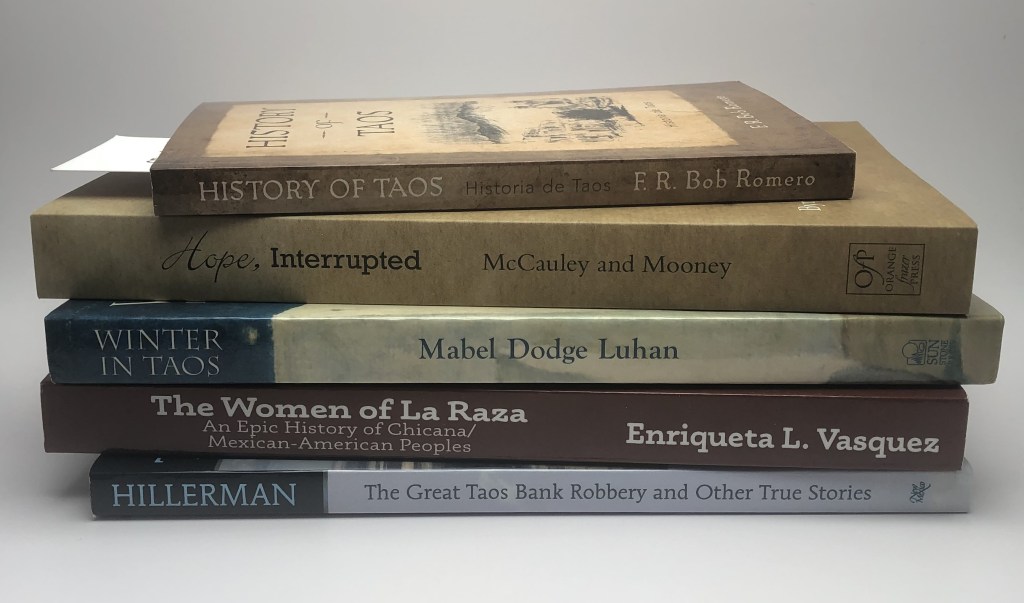
This week’s reading goes back to my trip last year to Taos. As a result, you get a bookstore and a book this week. I made sure to visit the local bookstore, op. cit. – the name of the bookstore is an abbreviation of a Latin term that means ‘in the work already cited’. There is also an outpost of this store in Santa Fe. https://www.opcit.com/ Taos is known for its artists and writers – I knew of the town because writer Natalie Goldberg has spoken of it in her writing many times. Therefore, I was excited to visit and take in the artistic and literary atmosphere, and, of course, a bookstore.
A big part of my travels involves visiting local bookstores and purchasing books (and bookmarks!) that are specific to the area. I used to buy the typical t-shirts and keychains as souvenirs, but on a 2010 trip to Europe I decided it was a good idea to buy location-specific books on vacation, and I have never looked back. My trip to Taos and op. cit. was no exception. I actually bought more books at this great store than I usually do. I went with both local authors and local stories.
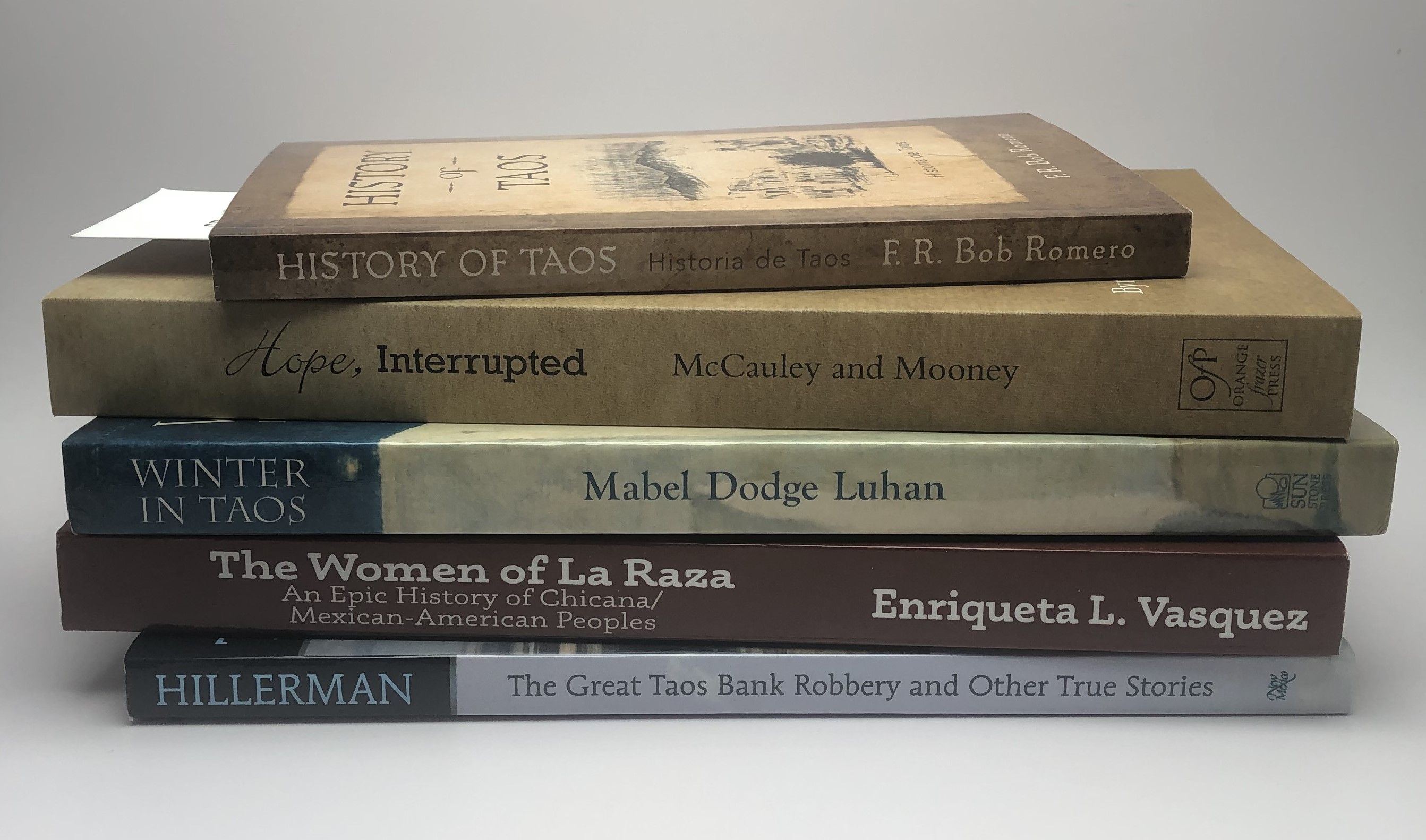
This week I am reading the tiny self-published History of Taos by F.R. Bob Romero. When traveling, I never want to just pass through a place without learning more about it (even if it takes me a year to pick up and read the book!). History of Taos starts with a visual timeline, which was a helpful overview to get started – it gave manageable scope to the long history of the area beginning with Native American habitation in 1000 to the hippie invasion in the 1960s. Native Americans have lived in the area for at least 1000 years, and still inhabit the Taos Pueblo. Spain and Mexico, and later the United States, have all laid claim to Taos. The book goes into each of these time periods, and dives into everything from historic revolts and historic churches to education and government. I am only halfway through, but after learning about the centuries of struggle for control of the town, I am looking forward to learning how the hippies landed in Taos and what brought them there.

This compact book is approximately 4”x6 and has 195 pages. While some histories can be dry and overloaded with facts, this one is very readable while at the same time thorough. It is written by an adjunct professor that teaches courses on the history of Taos and New Mexico and is well cited if you are interested in reading more about the area. I am sometimes skeptical of self-published works because of the lack of editing and proofreading, but this one has the polish of an academic work.
When you are traveling to an area, I recommend visiting local bookstores and buying books written by authors from the area. I purchase both nonfiction and fiction. Sometime the fiction is set in the area and other times it is just written by an author that lives there – either way I feel good about supporting local authors. I visited op. cit. in Taos and found many books that I wouldn’t find at any other bookstore, which is always what makes an independent bookstore special to me. As a traveler, I am not interested in showing up and buying a best seller that I could buy anywhere. If I am in Taos, I don’t want to buy something that I could just find at my local big box store. Op. cit. had many options by local authors and with local flavor. Talking to the local booksellers is part of the fun. The bookseller behind the counter gave me a postcard promoting the annual Taos Writer’s Conference, which takes place in July. She told me that she leads a group out into nature to write poetry inspired by the surroundings. While I do not write poetry, it sounded like a wonderful conference that I will consider attending in the future.
While Taos is a little out of the way (about an hour north of Santa Fe), I highly recommend a visit, and make sure you stop by and support the local independent bookstore and the writers of the area.
Feel free to share any local histories that you have found interesting!

 Michelle Rambles